“While I Continue to Pray for the Prosperity of that Government which Protects the Rights of a Poor Negro”: Fighting for Freedom in Newspapers and Court, Adam Vs David Cowell
By Miriam Morton, Lead Interpreter
2/27/2026
Introduction:
“Wishing that every foot may wear the shoe that fits it, while I continue to pray for the prosperity of that government which protects the rights of a poor Negro.” may not be the type of language one would expect to see in a newspaper advertisement during the Revolutionary War.1 What started out as a sale advertisement soon grew into a personal war between two individuals in Trenton, New Jersey, as they publicly argued and insulted each other in a heated debate over freedom. What you haven’t heard before is the story of Adam, a person of African descent living in Trenton, and David Cowell, his enslaver and a prominent doctor in town. While it is common to find repeat advertisements and records for enslaved men, it is rare to find a trail as direct and conversational as the one below.
While not much is known about Adam’s life prior to his enslavement to Cowell, through reading the advertisements and documents, some information can be gleaned and put together. From the information available through the newspaper exchange of Adam fighting for his freedom, Adam can be characterized as quick-witted, resourceful, and brave. Adam actively pursued this through numerous methods, including running away, publishing rebuttals to his enslaver’s claims in the newspaper, and attempting to go through the courts to obtain his freedom. Adam evaded the authorities and Cowell, but remained in abeyance, a state of legal suspension, for three years while this newspaper exchange unfolded, not quite in bondage but not legally free. In the first advertisement posted, Adam was described as being a healthy thirty-two-year-old in 1780, however, in most cases in runaway ads, the exact date of birth or age of an enslaved person is estimated and can vary greatly depending on how they are described in the advertisement.2 In Cowell’s first advertisement, Adam’s skills are listed; he was well-versed in agricultural techniques and methods, as well as in the care and management of horses. It can be assumed that Adam was skilled in other kinds of work, as Cowell hired him out to others in town. Some notable places he may have worked include Stacy Pott’s forge on what is known as Petty’s Run, behind the present-day Old Barracks in Trenton. Adam could have possibly worked at Stacy Pott’s Tannery or the hospital at the Trenton Barracks, assisting Cowell. This document, which will be shown below, illustrates an unusual agreement Cowell wrote expressing that Adam would have the rights of a free man economically, while simultaneously still being held in bondage.
David Cowell was born on May 28th, 1741, to Sarah and Ebenezer Cowell in Wrentham, Massachusetts. David Cowell was the nephew of Reverend David Cowell of the Presbyterian Church in Trenton. He graduated from Princeton College in 1763, then went on to study medicine in Philadelphia.3 He subsequently moved to Trenton, where he worked as one of the town’s three physicians. Multiple sources state that Cowell was enlisted in the militia during the Revolutionary War and served as a senior physician and surgeon; however, there is very little documentation of his actual service.4 He most likely served in another surrounding state, as he was not commissioned as a surgeon in New Jersey.5 David Cowell remained a bachelor and practiced medicine until his death in December 1783.
While it is impossible to know for certain the dynamics between him and others in town, Cowell seems to have been engaged in a long-standing feud with two particular members of the community: Nathan Beakes Jr. and Stacy Potts. Both Nathan Beakes Jr. and Stacy Potts were prominent members of the community as businessmen and Quakers. Their religion likely had an influence on their actions, and was clearly a divisive point of contention between the three men. Stacy Potts was one of Trenton’s leading industrialists, operating a tannery, steel factory, and paper mill at various points in his career. While little is known about Nathan Beakes Jr., it is known that Potts had a business relationship with him, often purchasing bark from Beakes and others in town to be used at the tannery. Tanned goods were used widely across different trades and sometimes clothing, with Potts being the main supplier in the area of leather for these goods. Potts additionally was engaged in town affairs, being elected clerk in 1774 and repeatedly elected the following terms.6
This battle between Adam and David Cowell seems to have started almost immediately following the 1778 document detailing an agreement between the two, which defines some parameters to the type of work and rights Adam has. Nine months later, in August 1779, Adam runs away to New York, but he is brought back and runs away again in October the same year. Cowell’s response to this was in January 1780, with the first in the series of advertisements posting a sale ad of Adam in the local paper. Adam published his thoughts in response, claiming that he is a free man and is protected by the laws of the state. From October 1779 to December 1783, Adam was able to seemingly evade Cowell’s attempts to have him return, as they continued their personal war in the newspaper, with each response getting more riled up than the last. Their newspaper exchange lasted three years, spanning from 1780-1783. Local historians like Larry Kidder, author of “Crossroads of the American Revolution” have written about this, however, new information has been found that provides a greater depth to the story.7 Cowell was simultaneously engaged in two Supreme Court cases as this exchange unfolds, one against a fellow Trentonian who he blamed for the loss of Adam’s labor, and the other is with the State of New Jersey for deciding Adam’s right to freedom. While others like Elizabeth Freeman, also known as Mumbet, petitioned the courts for their freedom, Adam’s case is more complicated.8 Rather than him directly petitioning for his rights, the state acted on his behalf, suing Cowell. Adam’s story stands out for the detail of the surviving secondary documentation, but for the record of his actions and words. Not only did he run away, but he directly confronted his enslaver in print and continued to seek his freedom through various means.
In 1775, Trenton’s population had a smaller population compared to larger cities like Philadelphia or New York, of about 900-1800 people living in town. Trenton’s proximity to the Delaware River made it an hub of inns, taverns, with a transient population engaging in trade and travel, making it an ideal place for merchants, shop owners, and tradesmen to sell their goods. Trenton was also a place where many enslaved men, women, and children passed through in an attempt to gain their freedom. While there was a population of both enslaved and free people of African descent living in Trenton, the surviving documentation is limited in number and detail.9 The African American population, both free and enslaved, was 7% of the total population by 1772 in Hunterdon County.10 Documentation of free people in the 18th Century primarily comes from records of manumissions, the written release from enslavement. Other records can be found in newspapers and court cases, sometimes mentioning a free person. Ships, ferries, and news all travelled through Trenton, including news of runaway advertisements.11 Trenton’s bustling commercial activity seems to have made it a place where those escaping slavery could utilize its location to their advantage.
The images below are a mixture of supporting documentation from Supreme Court cases involving Adam and Cowell, as well as the advertisements the two published. The documents are arranged by chronological order, and will have transcriptions attached in the appendix.
“In Every Respect as A Free Man”: Adam and Cowell’s Unusual Agreement
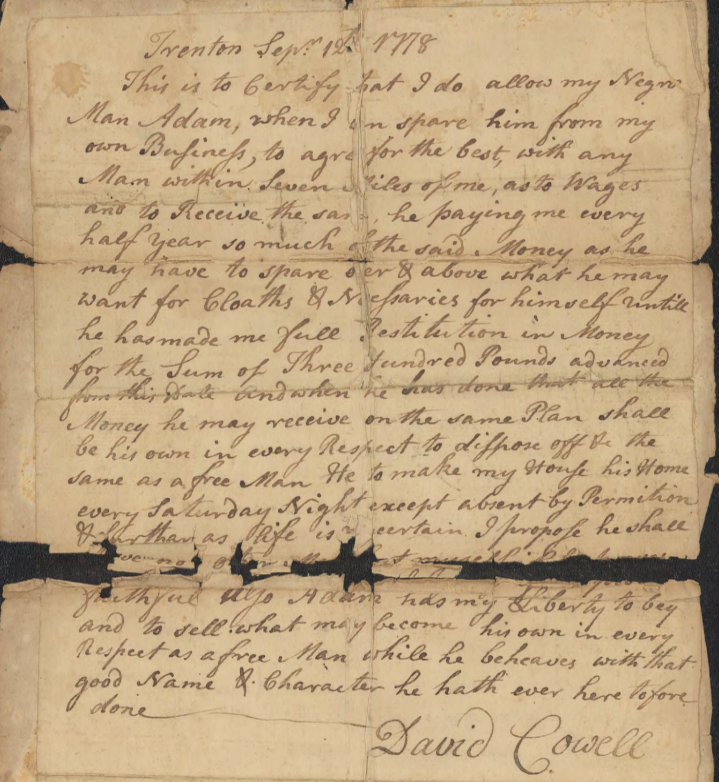
Supreme Court Case Files : Case # 5997 David Cowell v. Nathan Beakes Jr.
David Cowell wrote an agreement between himself and Adam in 1778, detailing what kinds of limitations would be established.12 However, this document is very unusual as it reads more similarly to the paternalistic language used in an agreement of an apprenticeship or indentured servant for the use of their labor, rather than what would be found when purchasing an enslaved individual. Apprenticeships in the 18th century commonly have contracts similar to this, of retaining and owning the person’s labor, but for a set period of about seven years.13 At the end of the contract, the apprentice is owed a certain amount of clothing and skills in the trade, among other things at the conclusion of their term.
Since there is no documentation found for Adam prior to this agreement with Cowell, it is difficult to verify what Adam’s life may have been like. There are a few possibilities about what his situation may have been; Adam could have been a free man or possibly passing through Trenton in the process of running away, and offered a job by Cowell with stipulations like those mentioned above, similar to an apprenticeship. Adam may have already been a skilled laborer or needed work to become skilled if already a free man. At the conclusion of an apprenticeship contract, the individual has gained skills in a specific type of labor, but is also owed clothes, tools, and sometimes money.14 Unlike an apprenticeship, there is no mention of an end to Adam’s labor or what he might be owed at the end of service, meaning this document would have essentially enslaved Adam without ever mentioning chattel slavery. If Adam was unaware of the full implications of the document and the lack of mention of an end to the use of his labor, it may have been presented as a path towards freedom. He may have interpreted it as if he paid the sum, and everything after was his to do as he wished, that he would be able to purchase his freedom.
However, if Adam was enslaved and purchased by Cowell, then this document is extremely unusual in that Cowell writes not once, but twice that Adam has the same rights economically as a free man. This does not come without conditions however, Adam was still very much held in bondage and with that, a set of expectations from Cowell. Adam was able to work within a limit of 7 miles for wages and receive them, but he was required to pay Cowell every six months all of it besides what is needed for clothes and necessities. This money would then go towards the lump sum amount of £300, to make restitution for what can be assumed to be the price Cowell purchased him for, or appraised his labor value at. However, an interesting addition is in the line that follows, that after Adam has paid the lump sum amount, any money he receives would now be his own, “…in every Respect to dispose off & the same &c the same as a free man”.15 Similar economic freedoms were sometimes given in manumission records as long as certain requirements were fulfilled. According to The Persistence of Slavery and Involuntary Servitude in a Free State (1685-1866) by Simeon Moss, manumission occasionally came with stipulations, “A slave was set free in Shrewsbury in 1756, on the condition that he pay the testator’s daughter 40 shillings a year. This arrangement reveals that the manumitted slave must have been able to earn his own keep and maintain his property as though he were a free man.”16 The person here was manumitted and required to pay the enslaver’s daughter forty shillings per year to be free; which bears resemblance to the agreement between Adam and Cowell.
Adam had an unusual position of having a certain level of financial freedom while simultaneously being held in bondage. The total sum of £300, while a significant amount of money in the period, would be possible to pay the restitution over a period of time. Adam’s interpretation of this most likely was that if he submitted the £300, it would be enough to buy his freedom, since he was already declared to have the same economic rights as a free man. However, despite the possibility of increased economic freedom, Adam remained constrained by the limits of slavery. This could have also been an arbitrary number Cowell set, intending for Adam to never achieve it. Cowell could have raised prices on Adam’s necessities, making sure that he would be unable to make restitution or claim that Adam’s freedom was never the original meaning of this document.
In the next passage, Cowell stipulated that although there are economic liberties, there is a reminder that he is still enslaved or controlled via contract. Cowell reasserted this power by requiring Adam to reside at his house every Saturday, with the only exception being if he has permission to leave. He stated that Adam will “have no other Master but myself if he proves faithful”.17 This line could mean that Cowell was willing to sell Adam if he disobeyed or behaved in a way he didn’t like, and be read as Cowell exhibiting possessive behavior. The line could also show an intention to enslave Adam for life, as he stated Adam would “have no other Master but myself.” Another statement regarding economic liberty is made in the next line, that “Also Adam has my Liberty to buy and sell what may become his own in every Respect as a free Man”.18 If Adam is enslaved, why would he be expressly given the right to control his money, as well as buy and sell items in every respect as a free man? This brings into question: How was this document interpreted differently by Adam and Cowell? What were Cowell’s intentions and meanings behind what is written?
“To Be Sold or Exchanged”: Initial Confrontation
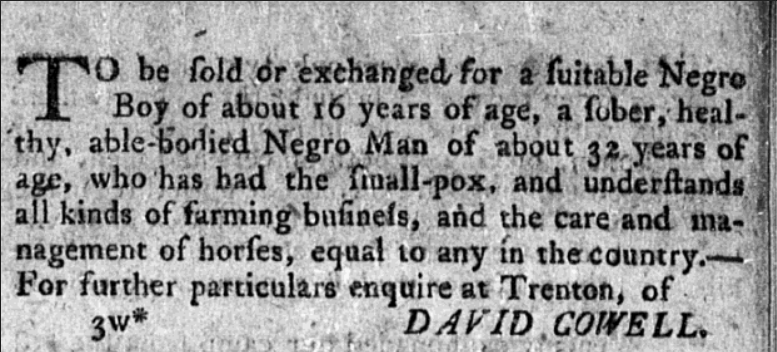
New Jersey Gazette, January 26, 1780
David Cowell placed an unnamed man for sale or in exchange for a young 16 year old boy. Because Cowell is only listed as having one enslaved person and no other servants or free men on the 1779 tax records, it is likely that the unnamed man is Adam.19 David Cowell described Adam’s skills and age but little details otherwise. Given the information published throughout this exchange provides context to Cowell and Adam’s dynamic, this sale ad could perhaps have been published as a punishment for Adam’s running away the previous October.20
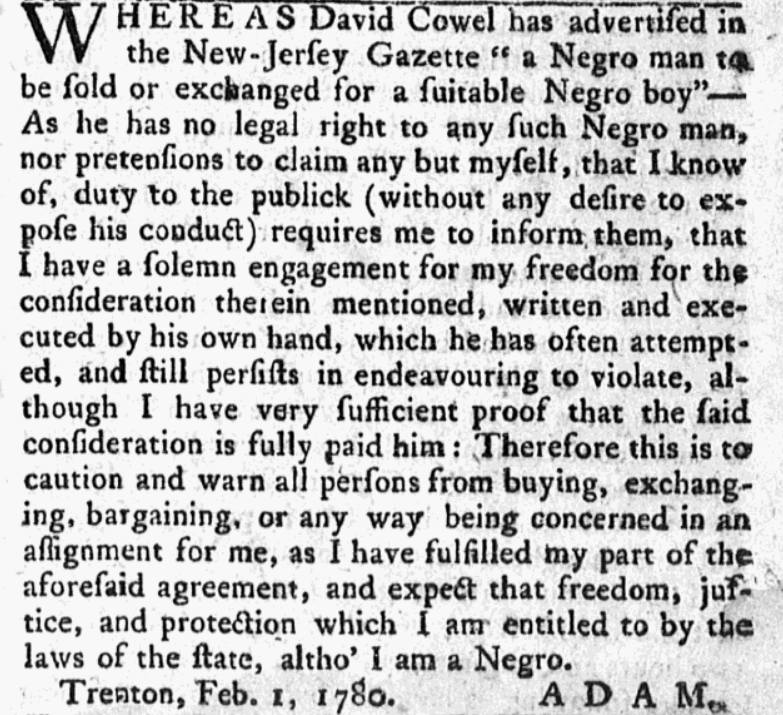
New Jersey Gazette, February 1, 1780
Adam responded six days later to David Cowell’s attempt to sell him, directly confronting him in the newspaper. While this whole story is unusual, this specific type of advertisement is almost nonexistent to come across, of the person who is the subject of a sale to respond. Not only was Adam responding openly to his enslaver in the paper, but he asserted that he is free, regardless of what Cowell publishes. Adam declared this publicly, responding: “As he has no legal right to any such Negro man…I have a solemn engagement for my freedom”.21
The tone used in the advertisement reveals a glimpse into their dynamic to one another; Adam spoke to Cowell as a peer and used language similar to that of a contract when referring to their agreement.22 Adam stated that Cowell wrote a consideration for his freedom. Assuming the word ‘consideration’ here is referring to the lump sum of £300 mentioned in the 1778 document above, he likely interpreted the completion of the repayment to have been the purchasing of his freedom. Adam stated that he has fulfilled the consideration and, despite having proof of completion, was still being faced with the violation of his rights. Adam cautioned the people of Trenton not to engage with Cowell’s advertisement, as Adam had completed his part of the agreement and should obtain the rights of a free man.23
Adam’s concluding statement that “… expect that freedom, justice, and protection which I am entitled to by the laws of the state, altho’ I am a Negro” is a powerful statement as Adam was reinforcing that he would be legally protected by the New Jersey Constitution. The Constitution was adopted in 1776, which allowed for free people, regardless of race, to vote, meeting certain requirements of land ownership or estate worth fifty pounds.24 Although Adam only referenced state law, the constitution states, “That all inhabitants of this Colony, of full age, who are worth fifty pounds, proclamation money, clear estate in the same, and have resided within the county in which they claim a vote for twelve months immediately preceding the election, shall be entitled to vote for representatives in council and assembly.”25 If Adam was previously free and had an estate valued at fifty pounds, he would have been able to vote and might have expected that those rights would follow him despite his circumstances. Rather than challenging the racialized system of slavery overall, he instead focused on the legal determination of the right to freedom. The language used shows that, despite the outright disadvantages he faced, Adam stated that he is equal to any man, regardless of race, in accordance with the laws of New Jersey, and entitled to his freedom like anyone else. Much of this advertisement speaks of the legality of ownership and the assurance that the law will provide the right of freedom, however, it brings into question if Adam might have had additional documentation, explaining his confidence in the state backing him in a time when chattel slavery was not often challenged in this manner.
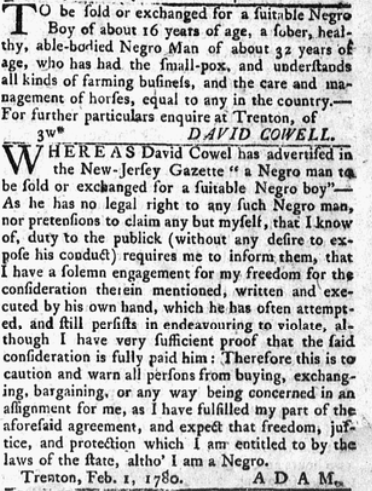
New Jersey Gazette, February 2, 1780
While this is a copy of the same advertisements listed above, the formatting of this reprint shows that these ads are in direct communication with each other. This was a deliberate choice to have the rebuttal published this way, perhaps to gain more attention to Adam’s plight and have others support him.26
“Has Not Got, Nor has Ever Had, any Written Engagement”: Cowell’s Rebuttal
New Jersey Gazette, February 23, 1780.
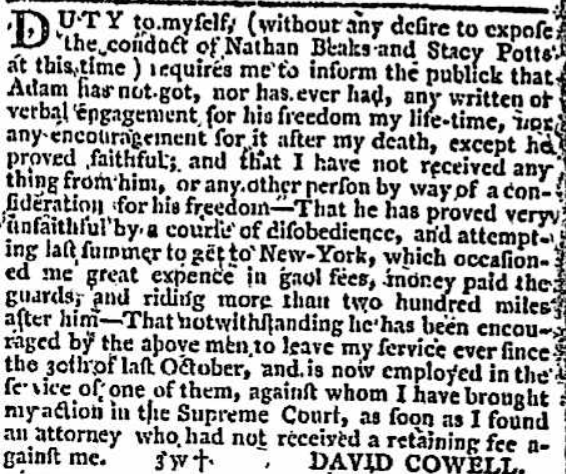
Cowell chose to engage and published a response twenty two days later, rather than simply ignoring what Adam wrote. Instead, he focused on engaging in a vigorous back and forth debate over the course of months, with each response becoming more passionate than the last. Although Cowell stated that he did not have any desire to expose others conduct, he still chose to name the individuals he blamed for Adam’s publications and running away. He accused Nathan Beakes Jr. and Stacy Potts as being involved.27
Although it is impossible to know for certain the motivations of these individuals, as Quakers, Stacy Potts and Nathan Beakes Jr. may have felt morally compelled to help Adam. Most people, both then and now, assume that Quakers were all abolitionists, but many in New Jersey actively participated in the slave trade. Some saw the Revolution as a reigniting return to Quaker principles and a chance to reform Quaker indifference towards the issue of slavery. However, Quaker thought at this time was often contradictory, as some tried to grapple with their own morality as the denomination began to advocate for abolition, however many still continued to refuse to manumit any of the people they enslaved. Quaker toleration of slavery was hypocritical, as some viewed their enslavement of African Americans as more acceptable than that of the larger population. In 1774, the Philadelphia Yearly Meeting warned enslavers that this would jeopardize their membership as abolitionist views grew within the Quaker community.28 In 1776, an official stance was taken that slavery was incompatible with Quakerism and that any defying this would be excommunicated and removed from meetings if they refused to manumit enslaved individuals.29
Cowell’s advertisement further complicates the story, as he seemingly backtracked from the certification document in 1778, in which he wrote that Adam could have a level of financial freedom if he met the stated requirements. However, Cowell could have never meant for the previous document to be taken as a promise of total freedom from enslavement, as he stated “Adam has not got, nor has ever had, any written or verbal engagement for his freedom in my life-time, nor any encouragement for it after my death.” Given that Cowell was specific that manumission was not available to Adam, it remains curious that the 1778 document was phrased offering the ability of maintaining finances and purchasing of goods the same as a free man. Cowell viewed Adam’s publishing of these ads and running away as a betrayal, as shown by him calling Adam “unfaithful”.30
This ad provides further context that this series of advertisements is not the first time that Adam attempted to assert his freedom; in the summer of 1779, Adam escaped Cowell’s household, and was captured 200 miles away in New York. While it is unclear if Nathan Beakes Jr. and Stacy Potts helped Adam during this escape, they likely had some kind of existing relationship with one another. Adam likely worked for both Beakes and Potts for a significant period between 1778 to 1780. Stacy Potts is listed in “Crossroads of the Revolution” by Larry Kidder as “often hiring local laborers for a day or so and sometimes paid masters for the work of their slaves.”31 According to Cowell, Beakes and Potts did encourage Adam to leave a few months later, in October of 1779, and assisted him in evading capture. This continued support likely influenced Adam to trust the two Quakers. As Adam had been absent from Cowell’s residence for a significant period, Cowell may have viewed the frequent running away as burdensome, leading him to post the advertisement. While it’s unclear if Beakes or Potts stood to benefit in any way from helping or if they believed in abolition, Adam certainly had everything to gain should his bid for freedom succeed. Nathan Beakes Jr. and Stacy Potts additionally placed retainment fees on the attorneys in Trenton, in order to prevent Cowell from moving forward with filing a Supreme Court case.32 The phrase “… as soon as I have found an attorney who had not received a retaining fee against me.” implies that Cowell was having trouble finding any lawyer, suggesting the Quakers split the cost to retain every lawyer in town. Not only did they, in Cowell’s eyes, deprive him of Adam’s labor and service, but deepened the personal aspect as the exchanges continued. Beakes and Potts could have kept the attorneys on retainment for as long as they would have liked so long as they continued to pay the fees. This would have been not only expensive but petty to a certain degree, considering the feud between the three men, serving not only to help Adam but to get at Cowell.33
“Renders his Person as Nauseous as his Character is Contemptible”: An Escalation in Tone
New Jersey Gazette, February 28, 1780
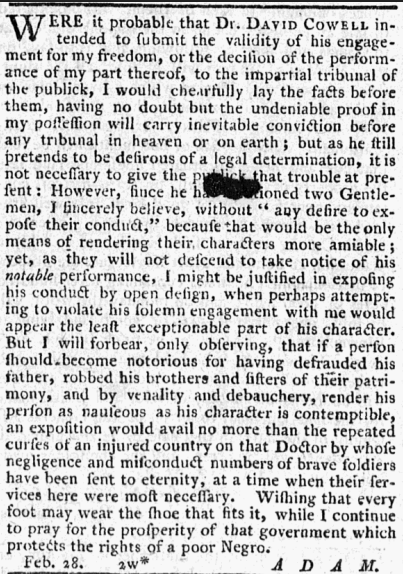
Adam published a response five days later, and whereas earlier he discussed not wanting to expose Cowell’s conduct, he does not show the same restraint in this advertisement. He called upon the public, that he would cheerfully present the facts to them of the undeniable proof in “any tribunal in heaven or on earth” of his status as a free man, but as David Cowell was determined to settle it legally, it wouldn’t be discussed fully in the papers. The phrasing and tone of the language used was very bold, as Adam pulled no punches and openly insulted Cowell.34
Although the language in the advertisements does not contain enough information to draw definitive conclusions about what Nathan Beakes and Stacy Potts’s relationship to Adam was like, Adam quickly defended their characters against Cowell’s previous publication. Adam argued that exposing the two Quaker’s conduct would only prove to show their character’s more likable. Potts and Beakes did not publish a rebuttal to these ads, viewing it as stooping to Cowell’s level. Adam openly criticized Cowell’s character and actions, stating that Cowell’s treatment of him was only one of the things that “renders his person as nauseous as his character is contemptible”. Adam publicized the rumors surrounding David Cowell, alleging that he cheated his siblings out of an inheritance and had issues with his father. Other people in Trenton seem to be aware of Cowell’s family issues, as both Benjamin Yard and Mary Case described difficult dynamics within the family in January 1784.35 Benjamin Yard stated that he was unaware of any fighting in the family, except between David and his father, Ebenezer, and two brothers, Ebenezer Jr. and Robert Cowell. Mary Case spoke of David Cowell coming to her home, telling her not allow her daughter (married to his other brother), to go to Ebenezer Jr.’s home. There seems to be no greater public response or defense to this assessment of Cowell’s character. Cowell’s behavior also serves to convince the public of Adam’s legitimacy; if it was well known in town that the criticisms stated are true, it lends more credibility to Adam’s argument that his rights have been violated. One question that comes to mind is, how is Adam able to publish and get away with all of these very direct and at times insulting responses to Cowell in a period in which this particular type of exchange is rarely found?
Isaac Collins, the printer of the New Jersey Gazette in Trenton, where all of these ads are published, certainly allowed this exchange to continue. Issac Collins moved to Trenton in 1778 to continue his printing business, where there was more economic opportunity and located ideally for various communication routes on land and by the Delaware River.36 Collins was a devout Quaker and was married to Rachel Budd of Philadelphia, whose mother was the great-granddaughter of Mahlon Stacy, a distant relative of Stacy Potts.37 In business, Collins published many pamphlets and books by Quaker authors, including the works of three antislavery authors, John Woolman, Anthony Benezet, and Granville Sharp, whose manuscripts were printed by Collins in 1772 and 1773.38 Benezet argued that the institution of slavery was “a tragic, sinful violation of the unconditional freedom given to each human being by God.”39 These would not be the last antislavery publications he would publish, as he devoted space on the front page to the Pennsylvania Gradual Abolition Act, passed in March 1780.40 Quakerism played a large part in West Jersey culture, including the moral revival and discussion surrounding slavery, favoring abolitionist views. This concurrent revolution within Quaker communities would have impacted Trenton as these ideas circulated in the paper and throughout the town.
Collins, as one of the printers for the revolutionary government and aligned with the patriot cause in his publishing, presented a conflict to Quaker pacifism. Quakers viewed any interaction with either the British or American causes as violating their beliefs, including obtaining an exemption from service. Although he did not serve in any militia, he did elect to be exempt from service to continue the newspaper, which was seen as equivalent in the Quaker view as if he had served.41 In 1778, Collins was expelled from the Quaker meeting, and would be an outsider for nearly ten years.42 As owner of the printing house and a general store, as well as being the editor and publisher of the newspaper, Collins remained a prominent citizen. His printing shop in the center of town became a popular meeting place for travellers and locals that the shop and his home became known locally as the “Quaker Tavern.”43 Despite his exclusion, he seemed to continue holding Quaker values and views, likely influencing his decision to continue publishing the advertisements between Adam and Cowell.
Collins may have had several motivations for allowing the advertisements between Cowell and Adam to continue. Most of this exchange was posted multiple times, with each posting requiring the subscriber (Cowell or Adam) to pay a fee based on length and placement. It could have been a financial matter, as the exchange grew more sensationalist, it would mean potentially selling more papers. These publications in the local paper likely further influenced Trenton Quakers to be motivated by the abolitionist pamphlets to act in their own daily lives.44 Collins for example, had at one time an enslaved person in his household, who he manumitted in the early 1770’s.45 Due to Collins’ previous works published and his presumed antislavery stance, perhaps he sympathized with Adam’s specific circumstances. As Adam would not have been able to go to the printing shop himself without risking being caught by the authorities, Beakes or Potts may have been the ones to publish the advertisements instead.
Adam alleged that Cowell, known as a senior physician and surgeon in the Continental Army, had neglected patients under his care during the war. This misconduct resulted in “numbers of brave soldiers have been sent to eternity, at a time when their services were most necessary”.46 This is a serious claim, one that Adam might have witnessed firsthand of Cowell’s treatment of patients if he assisted with medical duties. Little is known of Cowell’s wartime experience other than he has been consistently described as having served for two years as a senior physician, but no primary or secondary sources have currently been found to go in depth of his exact role. One of the only mentions of David Cowell in relation to his service is from an advertisement for the collection of linens and supplies to make bandages. According to the Pennsylvania Journal and Weekly Advertiser, July 17, 1776, Dr. Cowell is described as the designated person to send hospital supplies to in Trenton.47 It is possible that he may have been stationed in New Jersey for a time but enlisted with a militia in another state. As Cowell lived quite close to the Trenton Barracks, it is entirely possible that he may have served there for a period of time or in a flying hospital somewhere in New Jersey or surrounding states.48 Adam also highlighted Cowell’s hypocrisy to have served in the American Revolution and fighting for the belief in freedom, while enslaving another person. Adam served a biting remark at the end, that “Wishing that every foot may wear the shoe that fits it, while I continue to pray for the prosperity of that government which protects the rights of a poor Negro.”49 Adam’s open public shaming of Cowell was effective in that not only does the phrasing imply Adam’s restraint to resorting to this method, but it also reframed the situation for others of Cowell’s lack of accountability. Throughout the advertisement, Adam seems to be relying on popular revolutionary thought and this transitionary period in America of new ideas, rights, and liberties to support his case, hoping that the new governmental systems would protect him.
New Jersey Gazette, March 8, 1780
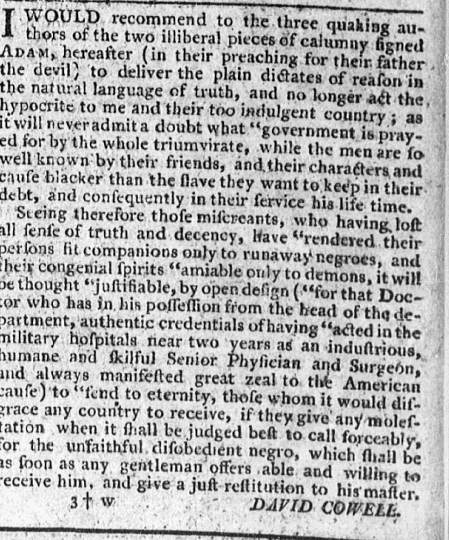
Cowell placed an ad ten days later in response to Adam. In the opening line, David Cowell denounced Nathan Beakes Jr., Stacy Potts, and an unknown third person, accusing them of writing the advertisements signed “Adam.” He called them “three quaking authors”, referring to their religion as Quakers and possibly their characters, viewing their writing to be a cowardly act. This might have been in reference to not only to how he viewed their helping Adam, but also to Beakes’ and Potts’ refusal to join the military due to their Quaker values and beliefs. As a military physician, he may have viewed it as unpatriotic on their parts to elect not to serve. Since the printing house was commonly referred to as “Quaker’s Tavern”, it is possible that Isaac Collins was the third unknown author and was more involved than meets the eye. Cowell further attempted to diminish their characters by retorting they are “preaching for their father the devil”, that what they are doing is so antithetical to how they should behave that there is no explanation for it. Cowell demanded that they write the truth and to no longer “act the hypocrite to me and their too indulgent country.” He referred to their actions working together as “the whole triumvirate”, a term originating in Ancient Rome, of a political institution being ruled or dominated by three men holding power and working together.50
Although it can be assumed that these advertisements were Adam’s sentiments, whether he was the author or dictating his thoughts, the possibility remains, as Cowell stated, that there were other writers. The feud between David Cowell, Nathan Beakes Jr., and Stacy Potts was increasing during this time, making it possible that the ads signed “Adam” may have been a space for Beakes and Potts to speak their minds without publicly attaching their names to the affair. They may have chosen to defend Adam in print because it was the right thing to do, maybe they stood to gain something from discrediting Cowell, or a number of reasons for assisting. It is unclear of the two Quaker’s exact motivations, but the various causes Adam, Beakes, and Potts had may have aligned with one another.
He attempted to slander them further by accusing them of wishing to steal Adam, insinuating that the “triumvirate” is only helping Adam so he will be indebted to them and remain “in their service his life time.” This advertisement’s language is reactive and phrased as if lashing out, as seen by the amount of times Cowell referenced in quotes Adam’s previous statements. In this same month, local elections were held, which likely increased Cowell’s frustration with this affair, as Stacy Potts was once again elected town clerk, a position Cowell himself desired, while Cowell received no office.51 According to Cowell, Beakes and Potts were miscreants who were disrupting their role within society. Cowell claims that by their actions, their souls are “amiable only to demons”. Cowell defended his military service, stating that he has proof of his authentic credentials from the head of the department, as well as extensive experience as a physician and surgeon. He also made sure to take note of his devotion to the American cause. David Cowell then called for Adam’s capture, to be brought back and restitution made for his absence. As Cowell’s reputation in Trenton seems to have been unfavorable, with both this string of advertisements and the issues with his family made public, this newspaper exchange may have further contributed to declining his reputation as each response gains more notoriety than the last.52
New Jersey Gazette, March 8, 1780
While this is a reprint of the previous ads, the placement choices by both parties shows how much this dispute has become a public affair. The printer, Isaac Collins, might have done this intentionally, as they are not only shown in succession but directly placed in conversation with one another. The inflammatory language used in the ads is especially prominent when viewing them in response to one another.53
“Contriving Craftily and Subtilly to Deceive and Defraud”: The £10,000 Lawsuit
In August, 1780, David Cowell brought this dispute to the attention of a higher authority, the Supreme Court. He filed against his fellow Trentonian, Nathan Beakes Jr. for the loss of labor and other damages, seeking compensation for time transpired since Adam’s absence from October 1779 to the filing of this lawsuit.
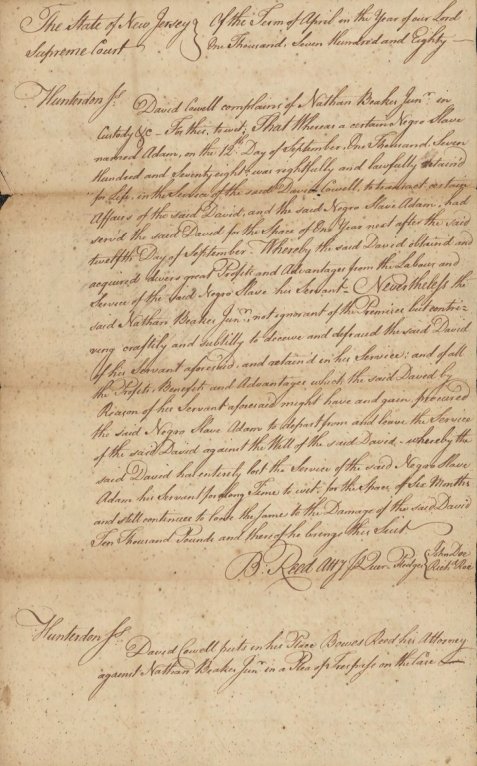
Supreme Court Case Files : Case # 5997 David Cowell v. Nathan Beakes Jr.
On August 14, 1780, David Cowell sued Nathan Beakes Jr. for his use of Adam’s labor, and the loss in profits on Cowell’s end. In this case, the earlier 1778 document established that Cowell had Adam’s labor and allowed him to work for others. Adam worked for David Cowell for one year until September, 1779 when he ran away and was able to go more than 200 miles away in New York. Cowell then retrieved Adam but lost his labor again, to Nathan Beakes Jr, where he most likely resided for a period of time. Cowell claimed that Beakes was aware of the arrangement and attempted to defraud him of Adam’s labor for the time of six months.54
In this document, when speaking about Adam in relation to Cowell, Adam was referred to as a servant, whereas when referring to him generally, he was mentioned as an enslaved person.55 However, the terms may have been meant to be viewed interchangeably, rather than as separate definitions of legal status. This raises the question, if Cowell had legal rights to Adam as ‘property’, why would he need to sue for labor? It’s possible that Adam may not have been legally enslaved, but rather his labor was contracted to Cowell for life. This supports that Adam could have been a free person prior to their arrangement, as the case of David Cowell v. Nathan Beakes Jr. only refers to the loss of service and labor, rather than the loss of a person in the form of property.
For this time lost, Cowell sued Beakes for the damage of £10,000 (an astronomical amount for the time), showing how highly he valued Adam’s labor. This could also have been Cowell’s own frustration at Adam, and an attempt at exerting power over him through the court of law to bring him back to Cowell’s residence. This case was not resolved until April 1783, when it was ruled there was to be no formal action taken against the Defendant, Nathan Beakes Jr. This meant that Cowell would not receive damages for the loss of Adam’s labor, including the compensation he requested.56
“A Free Negro in Your Custody Detained”: Adam’s Bid for Freedom
The document below shows another Supreme Court case, filed three years after the lawsuit between David Cowell and Nathan Beakes Jr. This case focused on determining Adam’s legal right to freedom.
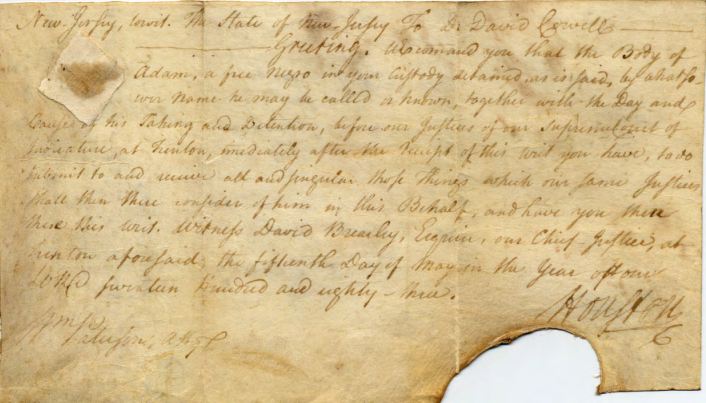
Supreme Court Case Files: Case # 34546 The State of New Jersey v. David Cowell
Three years later in May 1783, the state ordered David Cowell to produce Adam, a free person, claimed as enslaved to Dr. Cowell.57 This lawsuit was for the Habeas Corpus of Adam, the ruling of legal determination to secure a detained person’s release. The Supreme Court case of David Cowell v. Nathan Beakes Jr. referred to Adam as both an enslaved person and a servant, whereas in the case here for determining Habeas Corpus, Adam was referred to as a free person. It is unknown why this change in language was used, as even the law at the time raises questions about Adam’s legal status that are yet to be answered.58
To have been labeled a free person in the order for the court document, it demonstrates that there was enough of a consensus that Adam was free in some sense. Stacy Potts and Charles Axford Jr. acted as witnesses for the state on Adam’s behalf, most likely contributing more to David Cowell’s existing feud with Potts. Cowell was commanded to produce Adam and proof of the cause for his detention. Documents show that Adam was in Cowell’s custody for a short period to comply with the order to have him appear for the case. Unfortunately, the ruling of Habeas Corpus was not granted in Adam’s favour. The court ruled that Adam was to return to Cowell’s custody and be retained as enslaved for life.59
“The Constables Have not Been Able to Take Him”: Continuing to Seek Freedom
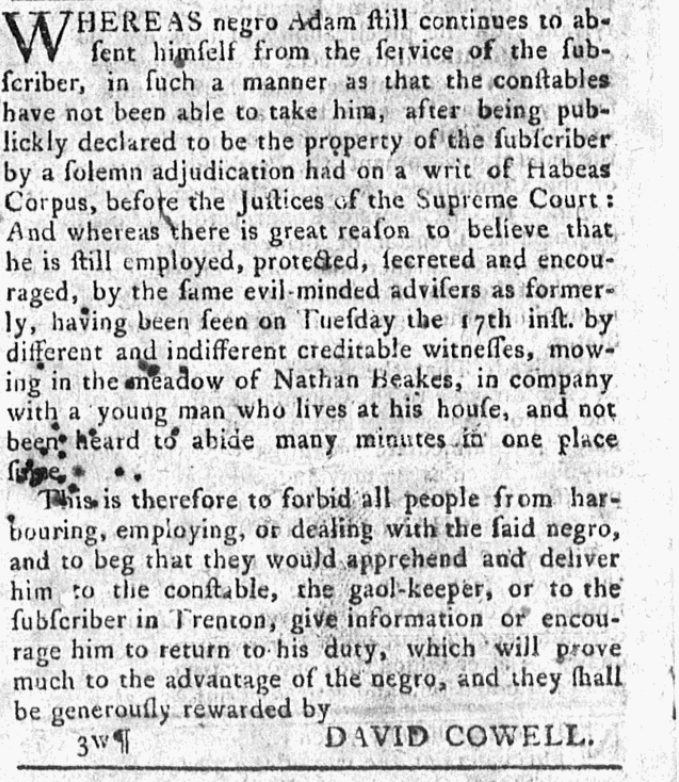
New Jersey Gazette, June 25, 1783
While the Habeas Corpus Case with the Supreme Court ruled against Adam’s right to independence, he did not give up on pursuing his freedom. Cowell posted another advertisement a month later, calling for Adam’s return, implying that he ran away again after the Habeas Corpus decision. It is possible that Adam may have remained in or around Trenton to see if he could overturn the ruling or attain legal documentation of his freedom. He continued to absent himself by staying at various people’s homes, never staying in one place long enough for Cowell or authorities to apprehend him. Adam was likely still being protected by the Beakes and Potts, as Cowell referred to them as “the same evil minded advisors.” The ad states that he was later seen in Nathan Beakes’s meadow and is presumably being hired by Stacy Potts or maybe other people in town, most likely using his skills in horse management and his knowledge of farming practices to find work. Cowell called for the public to not harbour him, but to bring him to the constable or himself and they would be rewarded for his return.60
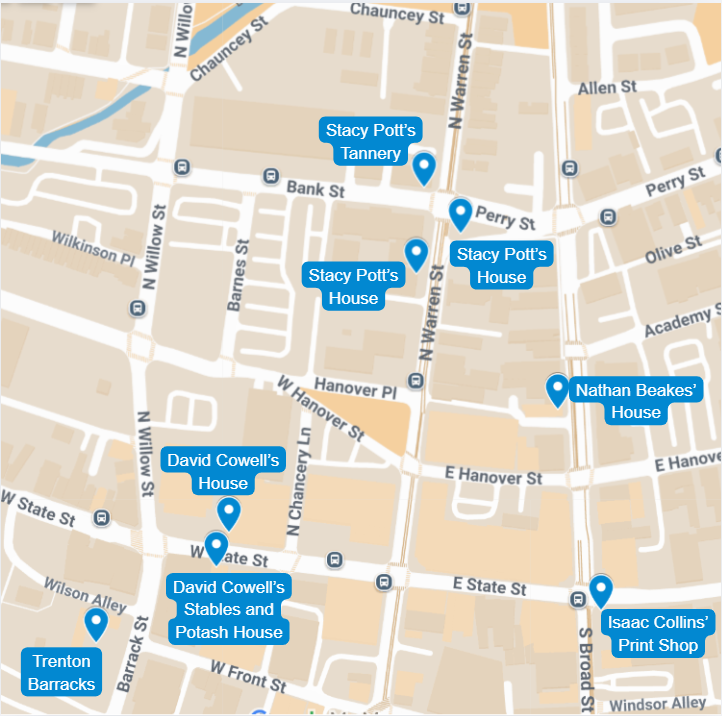
This map details the business and residences of David Cowell, Nathan Beakes Jr., Stacy Potts, and Isaac Collins. Although the map is modern, taken from Google Maps, the positions of the streets are the same as they were in the 18th century. With Trenton being a smaller community, they all lived relatively nearby, just a few minutes walk from one another, making it more remarkable that Adam was able to remain out of Cowell’s grasp while living and working in the same area.61
This brings the question: could Adam’s story have happened anywhere in New Jersey other than Trenton? While it is impossible to know the full culture of Trenton in the 1780’s, there are key differences between Trenton and other areas of New Jersey. Trenton, as an important crossing between New Jersey, Pennsylvania, and New York, with a thriving mercantile culture, saw many people passing through the town, including enslaved individuals seeking to gain their freedom, taking advantage of the placement by a border with easy access to a river, between larger urban areas of New York City and Philadelphia.62 By 1780, when most of these advertisements were published, Trentonians had already felt the effects of the Revolution, having experienced the Battle of Trenton and witnessed the changes society was undergoing as revolutionary thought and change spread. Despite multiple people siding with Cowell and informing him of Adam’s whereabouts, there does not seem to be great interest or urgency in capturing Adam. As Adam was likely well known in and around Trenton, this suggests that Trentonians were divided on this issue, with some reporting to Cowell where and when they saw Adam, and others hiring Adam for work or assisting him in some way. There are a few free Black men and women living in town who may have helped him, in addition to Beakes and Potts.63 Some Trentonians may have been quietly in favor of Adam and helped him indirectly by ignoring the issue and allowing it to play out. This debate over freedom and who gets access to it in a post-revolutionary society was being actively played out and debated in both in Trenton and in the New Jersey Gazette.
“The Whole Affair to the Presbyterian Church”: A Sudden Turnover
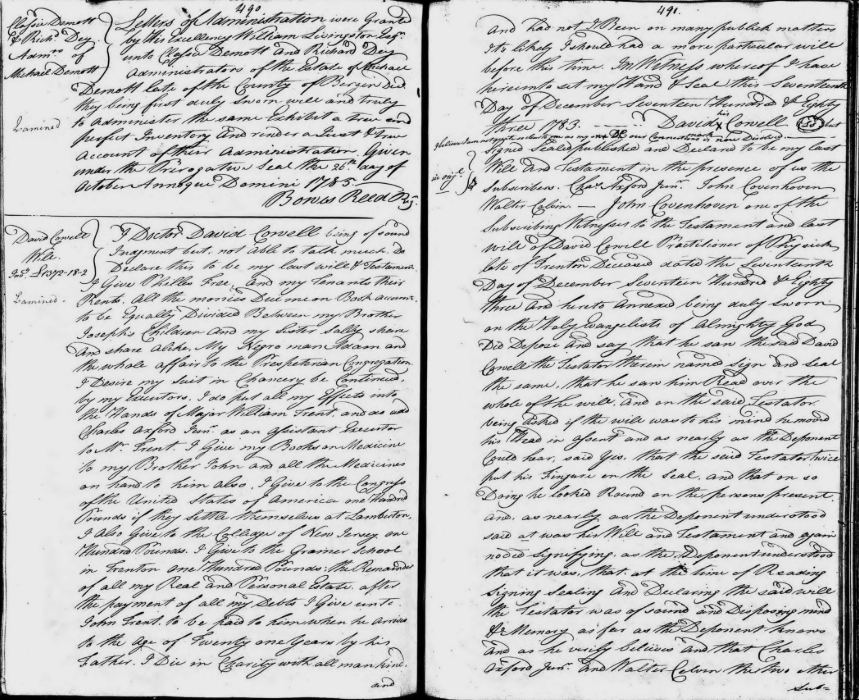
David Cowell’s Will, New Jersey State Archives, Wills and Probate Records 1705-1804, New Jersey Department of State.
Unexpectedly, David Cowell became sick with quinsey, a respiratory illness.64 As he struggled to make his last wishes known, he took the time to list Adam as one of the first orders of business.65 In his will, David Cowell still refused to acknowledge Adam’s right to freedom, as he bequeathed both Adam himself and “the whole affair” of the yet-ongoing legal battle to the Presbyterian Church.66 He may have hoped that the matter would be resolved, as he gave them total control over Adam’s fate. Although it is unknown what happened in regards to the relinquishing of Adam to the church, it did not mean he was free, as he would have been legally owned by the church instead. According to Jennifer Oast’s “Institutional Slavery: Slaveholding Churches, Schools, Colleges and Businesses in Virginia 1680-1860,” enslaved people would be instead hired yearly to create an endowment fund for the church’s use, something that was not unusual for Presbyterian Churches, especially in the Pre-Revolutionary period.67 However, rather than the legal ownership belonging to a single person, as it was with Cowell, the congregation as a whole would have shared ownership. In these circumstances, the church would use the profits to pay the minister’s salary, other expenses, and building maintenance.68 It is possible that the Presbyterian Church may have had Adam, but hired him out to the highest bidder in the congregation on a yearly basis, if they were able to capture him. This type of institutional slavery was considered much more brutal, as the enslavers often had no long-term interest in their welfare, only the profits that could be made in a year.
There is no current evidence to suggest that Adam had returned to Cowell’s residence at this time, or that he was ever formally in the custody of the Trenton Presbyterian Church. Research was conducted into the larger archives at the Presbyterian Historical Society in Philadelphia, but no evidence was found in the records of the Trenton Presbyterian Church that mentions Adam. Despite there being detailed records kept prior to and after December 1783, there was no mention of Adam, Cowell, or this affair in the congregation’s notes. As the Trenton Presbyterian Church had a small congregation, some might have disagreed with the practice, leading to the decision not being recorded. Further research could be conducted on the Quaker Meeting notes to see whether he was mentioned there. Since authorities and townsfolk were unable to catch him before, it is less likely that anyone would be motivated to do so after Cowell’s death.
“Fellow has Claimed his Freedom for Some Time”: A Possible Continuation of Adam’s Story
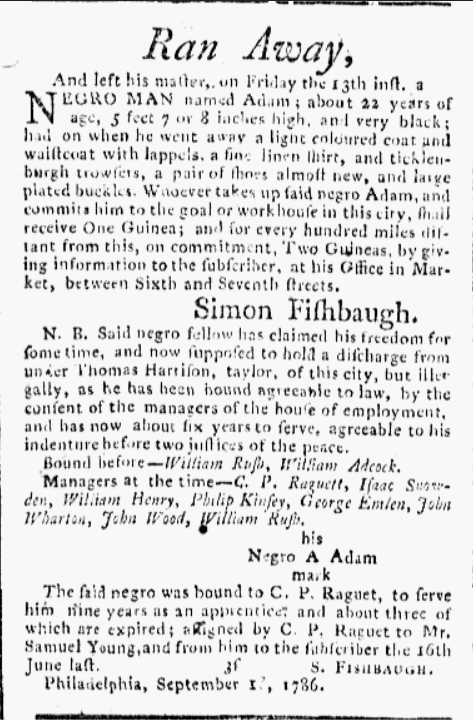
Pennsylvania Packet, September 11, 1786.
While Adam’s fate is currently unknown, another advertisement has been found that offers a possibility of the continuation of his story. This advertisement, much like the rest of his story, is quite unusual. The advertisement starts out similarly to other runaway ads, but after the enslaver’s signature, the information provided reveals a deeper story. Rather than stating that he was enslaved, he seems to have been bound under an indenture with a limit to the time he would serve. It is possible that he left Trenton after Cowell’s death in pursuit of another way to seize his freedom.
Although Adam’s age is different from the other advertisements, it is possible it was mistyped or that the estimation was off, as many advertisements only provide an estimate of age that is not always correct. Partway through his service, he saw an opportunity to run again, acquiring an illegal discharge from a local tailor, after which this advertisement is placed. This discharge would have allowed Adam to get away further and provided documentation should anyone question his status. While it is unclear what the discharge itself said, it likely released him from the indenture, stating that Adam was a free man.69
Simon Fishbaugh stated that “…every hundred miles distant from this, on commitment, Two Guineas, by giving information to the subscriber.” Most advertisements that post specific distances are usually limited to about 50 miles or less; it is uncommon to see one listing for the possibility of multiple hundreds of miles. Running away one hundred miles is no small feat; this shows a confidence from Fishbaugh that Adam could get away to a further distance. The main clue that makes this advertisement intriguing is that Adam was said to have been claiming his freedom for some time, which could be referencing the advertisement exchange as well as his repeated run away attempts. This advertisement comes three years after Adam’s last known whereabouts in Trenton, lining up with the time Adam would have served by this point. What is so curious about this advertisement is that it also includes the indenture within it, of the terms, as well as Adam’s mark/signature. According to “The Persistence of Slavery and Involuntary Servitude in a Free State” by Simeon Moss, “It was also a frequent practice to defer manumission through the process of indentured servitude. Where this was done, the will usually stipulated the number of years a slave would have to serve under the indenture, after which he was to be set free.”70 Although Cowell did not stipulate manumission in his will, Adam may have reached an agreement with a Philadelphian, offering his skills for a number of years, with the promise of freedom through indenture. He signed before two Justices of the Peace and other witnesses, to be an indentured servant for nine years, and had already completed three years by the time of this advertisement. Adam was originally indentured to C.P. Raughout, then to a Mr. Samuel Young, then finally to the subscriber of this ad (whom Adam ran away from), Simon Fishbaugh. This advertisement offers evidence to the possibility that Adam decided staying in Trenton was no longer a viable path to freedom, leading him to choose to seek it elsewhere.71
Conclusion:
Although not much is known about Adam’s life beyond these documents, the available information provides important context to help understand the depth of the situation. Having the record of Adam’s words in his lifetime, publicly voicing his opinion against David Cowell, remains a powerful and compelling act nearly 250 years later. David Cowell, Nathan Beakes Jr, and Stacy Potts were engaged in their own battle of conflicting ideals and interests, with Adam at the center of the dispute. Many authors found the information about Adam and Cowell in the runaway advertisements, providing a deeper look at life in Trenton during this time. Adam’s story reflects, on an intimate scale, the larger issues that revolutionary society had to grapple with: what freedom means, who gets access to it, and how to navigate their changing world.
The depth of information in these surviving records shows the harrowing, long fight to determine what freedom means socially, economically, and legally. The supporting documentation through advertisements and Supreme Court records provides context to the complex dynamic between Adam and David Cowell that may not have been found otherwise. While there are examples of enslaved men, women, and children being the subject of Habeas Corpus, there are rarely examples of the individual’s own thoughts and words, especially aimed at their enslaver. Adam took control of his narrative, not only challenging the person directly responsible, but also the larger community as a whole by publishing these ads for everyone to see. While Adam’s exact legal status of enslaved, indentured servant, or a free individual is somewhat undetermined at different points of his story, he pursued any means necessary to attain freedom. However, the ambiguity surrounding the ads and his fate suggests there may be more to the story.
Despite being unable to track Adam’s whereabouts with certainty, his story was remembered by the Presbyterian congregation 129 years later. In a 1912 sermon, the Trenton Presbyterian Church Reverend Henry Collin was given as part of the 200th anniversary of the Trenton Presbyterian Church’s founding.72 This sermon focused on the changes the world and the congregation had seen during that time, drawing information from John Hall’s History of the Presbyterian Church in Trenton, N.J.: from the first settlement of the town. Henry Collin referenced David Cowell’s will, speaking of Adam’s bequeathment to the congregation.73 He goes on to speak of the progress of the church, that congregations would be remiss to not stand against slavery. Although mentioned briefly to speak of social progress from the past, this shows that it stood the test of time as a known history within the congregation.
While many of the questions posed in this paper will remain unanswered, these documents offer a glimpse into the feelings, motivations, and power struggles within the conflict. While Adam may not have been able to get justice in his time, sharing his story not only highlights his efforts but also provides a foundation for finding more stories like this in New Jersey. We hope to uncover more about Adam’s story in continued research in 2026 and forward.
The additional materials, such as transcribed court documents and tax records, will be linked to this article.
The author wishes to thank the Trenton Presbyterian Church, Trenton Quaker Meeting, Philadelphia Presbyterian Historical Society, and the New Jersey State Archives for their time and resources. I would like to thank my colleagues, particularly Daryian Kelton, Jonah Horvath, David Niescior, and Mark Turdo, for their conversation and thoughts on this paper.
Appendix
- Supreme Court Case Files : Case # 5997 David Cowell v. Nathan Beakes Jr.
Transcription:
Trenton, Sepr: 12th 1778
This is to Certify that I do allow my Negro Man Adam, when I can spare him from my own Business, to agree for the best, with any Man within Seven Miles of me, as to Wages and to Receive the same, he paying me every half year so much of the said Money as he may have to spare over and above what he may want for Cloaths & Necessaries for himself untill he has made me full Resitution in Money for the Sum of Three Hundred Pounds advanced from this Date and when he has done that all the Money he may receive on the same Plan shall be his own in every Respect to dispose off & the same &c the same as a free man. He to make my House his Home every Saturday Night except absent by Permission & [?] as life is certain. I propose he shall [have no other Master but myself if he proves?] faithful. Also Adam has my Liberty to buy and sell what may become his own in every Respect as a free Man while he beheaves with that good Name & Character he hath ever here tofore done
David Cowell74
- Supreme Court Case Files : Case # 5997
David Cowell v. Nathan Beakes Jr. Trespass on the Case (£10,000 damages; for depriving David Cowell of the service of Adam, a Negro slave). [File includes a letter dated September 1778 in which David Cowell sets forth that Adam may work for others] Hunterdon : 1780 – 178375
The State of New Jersey Supreme Court } Of the Term of April in the Year of our Lord One Thousand Seven Hundred and Eighty
Hunterdon Js: David Cowell complains of Nathan Beakes Junr: in Custody &c. For this, to wit, That Whereas a certain negro Slave named Adam, on the 12th Day of September, One Thousand Seven Hundred and Seventy eight was rightfully and lawfully retain’d for Life, in the Service of the said David Cowell, to transact certain Affairs of the said David, and the said Negro Slave Adam, had serv’d the said David for the Space of One Year next after the said twelfth Day of September. Whereby the said David obtain’d and acquired divers great Profits and Advantages from the Labour and Service of the said Negro Slave, his Servant. Nevertheless, the said Nathan Beakes Junr, not ignorant of the Premises but contriving craftily and subtilly to deceive and defraud the said David of his Servant aforesaid, and resin’d in his Service: and of all the Profits, Benefits, and Advantages, which the said David by Reason of his Servant aforesaid might have and gain procured the said Negro Slave Adam to depart from and leave the Service of the said David against the Will of the said David, whereby the said David has entirely lost the Service of the said Negro Slave Adam his Servant for a long Time to wit: for the Space of Six Months and still continues to loose the Same to Damage of the said David Ten Thousand Pounds and thereof he brings this Suit
B: Reed Atty Pr Quer. Pledges { John Doe
Rietd Doe
Hunterdon Js: David Cowell puts in his Place Bowes Reed his Attorney against Nathan Beakes Junr in a Plea of Trespass on the Case
- Supreme Court Case Files: Case # 34546
State of New Jersey v. David Cowell (Dr.; Enslaver of Adam)
Habeas Corpus (to produce Adam, a 1783 free Negro; claimed as slave by Dr. David Cowell) Minute Book 61, p. 193; 225
New Jersey, to wit. The State of New Jersey To Dr. David Cowell — Greeting. We command you that the Body of Adam, a free negro in your Custody detained, as is said, by whatsoever name he may be called or known, together with the Day and Cause of his Taking and Detention, before our Justices of our Supreme Court of Judaiture, of Trenton, imediately after the Receipt of this writ you have, to do submit to and receive all and singular those things which our Same Justices shall then there consider of him in this Behalf, and have you then there this writ. Witness David Brearly, Esquire, our Chief Justice, at Trenton, aforesaid, the fifteenth Day of May in this Year of our Lord Seventeen Hundred and eighty three. Houston76
- David Cowell
Will }
[?]
Examined
I Doctor David Cowell being of Sound judgement but not able to talk much. Do Declare this to be my last will & testament. I Give Phillis Free, and my tenants this Rent. All the monies Due me on Book account to be Equally Divided Between my Brother Joseph’s Children and my Sister Sally [?] and share alike. My Negro man Adam and the whole affair to the Presbyterian Congregation. I desire my suit in Chancery to be continued by my Executors. I do put all my Effects into the Hands of Major William Trent, and [?] and Charles Axford Junr as an Assistant Executor to Mr. Trent. I Give my Books and Medicine to my Brother John and all the Medicines on hand to him also. I Give to the Congress of the United States of America one hundred Pounds if they settle themselves at Lamberton. I also Give to the College of New Jersey one Hundred Pounds. I Give to the Gramer School in Trenton one Hundred Pounds; the Remainder of all my Real and Personal Estate after the payment of all my Debts I Give unto John Trent, to be paid to him when he arrives to the age of Twenty one Years by his Father. I Die in Charity with all mankind and had not I Been on many publick matters It’s likely I should had a more particular will before this time. In Witness whereof I have [?] to set my Hand & Seal this Seventeenth Day of December Seventeen Hundred & Eighty three 1783. — David Cowell His Mark
But I believe I am not quite so clear to me as my own DC our Connections is now Disolved. —
Signed Sealed published and Declared to be my last Will and Testament in the presence of us the Subscribers. Chas Axford Junr John Covenhoven Walter Colvin John Covenhoven one of the Subscribing Witnesses to the Testament and last will of David Cowell Practicitioner of Physick, late of Trenton Deceased dated the Seventeenth Day of December, Seventeen Hundred & Eighty three and hereto annexed being only sworn on the Holy Evangelists of Almighty God Did Depose and say that he saw the said David Cowell the Testator therein named Sign and Seal the same, that he saw him Read over the whole of the will. And on the said testator being asked if the will was to his mind be moved his head in assert and as nearly as the Deponent could hear, said Yes, that the said Testator twice put his Finger on the Seal, and that on so Doing he looked Round on the persons present and, as nearly as the Deponent understood said at was his Will and Testament and again nodded signifying as the Deponent understood that it was that at the time of Reading Signing Sealing and Declaring the said will the Testator was of sound and Disposing mind & Memory as far as the Deponent knows and as he verily believes and that Charles Axford Junr and Walter Colvin the two other sub77
Bibliography
Bruns, Roger A. “A Quaker’s Antislavery Crusade: Anthony Benezet” In Quaker History. Autumn 1976, Vol. 65, No. 2, Friends Historical Association, 1976.
David Cowell v. Nathan Beakes Jr., 5997 N.J. SSV00001 (1780 – 1783), https://www.nj.gov/state/darm/SupremeCourtPDF/SSV00001_Supreme_Court_Case_No_5997.pdf
Elizabeth Freeman Center. “Who We Are: Who Was Elizabeth Freeman”. Accessed February 16, 2026. https://elizabethfreemancenter.org/who-we-are/elizabeth-freeman/
Hall, John. History of the Presbyterian Church in Trenton, N.J.: from the first settlement of the town. 2nd ed. Trenton, N.J.: MacCrellish & Quigley, printers, 1912.
Halsey, Luther Foster. The Revolutionary Worthies of the Medical Staff. Review Printing House, 1891.
Hixson, Richard F. Isaac Collins A Quaker Printer in 18th Century America, New Brunswick, New Jersey: Rutgers University Press, 1968.
Hodges, Graham Russell. Black New Jersey: 1664 to the Present Day. New Brunswick: Rutgers University Press, 2019.
Hodges, Graham Russell, and Alan Edward Brown. “Pretends to be Free”: Runaway Slave Advertisements from Colonial and Revolutionary New York and New Jersey. New York: Fordham University Press, 2019.
Hutchinson, Elmer T, editor. Documents Reading to the Colonial, Revolutionary, and Post-Revolutionary History of the State of New Jersey. 1st Series, Volume 35. New Jersey Historical Society, MacCrellish & Quigley Co Printers, 1939.
Hutchinson, Elmer T, editor. Documents Reading to the Colonial, Revolutionary, and Post-Revolutionary History of the State of New Jersey. 2nd Series, Volume 1. New Jersey Historical Society, MacCrellish & Quigley Co Printers, 1939.
Kidder, William L. Crossroads of the Revolution: Trenton 1774-1783. Knox PR, 2017.
Minton, Henry Collin. “A HISTORICAL SERMON, Delivered Sunday, October 20, 1912, in the First Presbyterian Church, Trenton, N. J., on the Occasion of the Two Hundredth Anniversary of Its Organization.” Journal of the Presbyterian Historical Society (1901-1930) 7, no. 2 (1913): 86–95. http://www.jstor.org/stable/23323152.
Monthly Meeting of Friends of Philadelphia, Philadelphia Manumissions Book, Haverford College, Haverford College Quaker & Special Collections, 1772-1786, page 65.
Moss, Simeon F. “The Persistence of Slavery and Involuntary Servitude in a Free State (1685-1866)” In The Journal of Negro History, Vol. 35, No. 3, 1950.
New Jersey State Archives, Department of State. Tax Rateables 1779. Revolutionary War Era Records.
New Jersey State Archives, Department of State. Tax Rateables 1786. Revolutionary War Era Records.
New Jersey State Archives, Wills and Probate Records 1705-1804, New Jersey Department of State, Probate Place.
Oast, Jennifer. Institutional Slavery: Slaveholding Churches, Schools, Colleges, and Businesses in Virginia, 1680-1860. New York, NY: Cambridge University Press, 2016.
Provincial Congress of New Jersey. “1776 State Constitution.” New Jersey Department of State. Accessed February 20, 2026. https://www.nj.gov/state/archives/docconst76.html#page3.
Rorabaugh, William J. The Craft Apprentice – From Franklin to the Machine Age in America. New York: Oxford University Press, 1986.
Satterthwaite, Elizabeth B. History of “The Religious Society of Friends of Trenton and Vicinity”. Trentoniana Collection, Trenton Free Public Library, 1931.
State of New Jersey v. David Cowell, 34546 N.J. SSV00001 (1783), https://www.nj.gov/state/darm/SupremeCourtPDF/SSV00001_Supreme_Court_Case_No_34546.pdf
Endnotes
- New Jersey Gazette, February 28, 1780, 3.
- New Jersey Gazette, January 26, 1780, 4.
- John Hall. History of the Presbyterian Church in Trenton, N.J.: from the first settlement of the town, 2nd Edition, (Trenton, New Jersey, MacCrellish & Quigley, 1912), 177.
- John Hall, History of the Presbyterian Church in Trenton, N.J.: from the first settlement of the town, (Trenton, New Jersey, MacCrellish & Quigley, 1912) 177.
Luther Foster Halsey. In The Revolutionary Worthies of the Medical Staff, (Review Printing House, 1891), 32.
Elmer T. Hutchinson, editor. Documents Reading to the Colonial, Revolutionary, and Post-Revolutionary History of the State of New Jersey. 2nd Series, Volume 1. (Trenton, New Jersey, MacCrellish & Quigley Co Printers, 1939), 146.
- Luther Foster Halsey, In The Revolutionary Worthies of the Medical Staff, (Philadelphia, Pennsylvania, Review Printing House, 1891) 32.
- William L. Kidder, Crossroads of the Revolution: Trenton 1774-1783, (Lawrence Township, New Jersey, Knox Press, 2017) 15.
- These advertisements are not unknown, with the sale advertisement and Adam’s response being published in other works such as; “Black New Jersey: 1664 to the Present Day” by Graham Russell Gao Hodges, “Pretends to Be Free”: Runaway Slave Advertisements in Colonial and Revolutionary New York and New Jersey by Graham Russell Gao Hodges and Alan Edward Brown, Editors (New York and London, Garland Printers, 1994), “Crossroads of the American Revolution” by Larry Kidder.
- In 1781, Mumbet and an enslaved man named Brom petitioned for their freedom in Massachusetts on the basis of the Constitution, that all people are allowed freedom. Others had been there to petition as well, but their arguments focused on loopholes in the law, whereas Mumbet’s case took a more radical stance for the time. This advanced to higher courts as Brom and Bett v. Ashley, and on August 22, 1781, they were granted immediate release from enslavement and given 30 shillings each. Mumbet went on to choose the name Elizabeth Freeman and was able to eventually purchase a house and land for herself and her children. See “Who We Are: Who Was Elizabeth Freeman”, Elizabeth Freeman Center, Accessed February 16, 2026, https://elizabethfreemancenter.org/who-we-are/elizabeth-freeman/.
- According to tax ratables of 1779, there were 36 enslaved men living in Trenton, and 48 enslaved men in 1786. The number of African American residents in Trenton is likely much larger, as women and children were often not included in these numbers. Women were not taxed, and therefore not listed in these records. Children were not counted until a certain age. Free people were also not necessarily included, unless they owned land to pay taxes. See New Jersey State Archives, Department of State, Tax Rateables 1779, 2.
- Simeon F. Moss, “The Persistence of Slavery and Involuntary Servitude in a Free State (1685-1866)” In The Journal of Negro History 35, no. 3 (1950), 310.
- What are runaway ads? Runaway advertisements were widely published in newspapers in the Eighteenth Century. These advertisements were placed by enslavers, often detailing clothing, any distinguishing scars or features, and sometimes a short description of the items an individual or individuals took with them. Advertisements would be posted across multiple newspapers or published multiple times to attempt to capture the enslaved person running away. Those running away employed several methods to try to escape, including; changing their appearance/clothes, changing their name, going to larger urban areas to try to blend in, etc. Some went on to larger cities to blend into free populations there, others came through looking to reunite with family, or used ships to get further away. These advertisements are important as they can offer a glimpse into the experiences of enslaved men, women, and children as they sought their freedom.
- David Cowell v. Nathan Beakes Jr., 5997 N.J. SSV00001 (1780 – 1783), https://www.nj.gov/state/darm/SupremeCourtPDF/SSV00001_Supreme_Court_Case_No_5997.pdf. For those interested in the full transcription, see Appendix A.
- William J. Rorabaugh, The Craft Apprentice – From Franklin to the Machine Age in America, (New York: Oxford University Press, 1986), 4.
- Ibid, 7.
- David Cowell v. Nathan Beakes Jr., 5997 N.J. SSV00001 (1780 – 1783), https://www.nj.gov/state/darm/SupremeCourtPDF/SSV00001_Supreme_Court_Case_No_5997.pdf
- Simeon F. Moss, “The Persistence of Slavery and Involuntary Servitude in a Free State”, (Chicago, Illinois, The University of Chicago Press, 1950), 300.
- David Cowell v. Nathan Beakes Jr., 5997 N.J. SSV00001 (1780 – 1783), https://www.nj.gov/state/darm/SupremeCourtPDF/SSV00001_Supreme_Court_Case_No_5997.pdf
- Ibid.
- New Jersey State Archives, Department of State, Tax Rateables 1779, 2.
- New Jersey Gazette, January 26, 1780, 4.
- New Jersey Gazette, February 1, 1780, 3.
- Although it is unknown whether Adam wrote or dictated this ad, or had others assisting him with the publication, this remains a powerful statement towards Cowell as he argued for his rights.
- New Jersey Gazette, February 1, 1780, 3.
- Provincial Congress of New Jersey. “1776 State Constitution.” New Jersey Department of State. Accessed February 20, 2026. https://www.nj.gov/state/archives/docconst76.html#page3.
- Ibid.
- New Jersey Gazette, February 2, 1780, 3.
- New Jersey Gazette, February 23, 1780, 3.
- Roger A. Bruns, “A Quaker’s Antislavery Crusade: Anthony Benezet” In Quaker History, Autumn 65, no. 2 (1976), 91.
- Ibid.
- New Jersey Gazette, February 23, 1780, 3.
- William L., Kidder, Crossroads of the Revolution: Trenton 1774-1783 (Lawrence Township, New Jersey, Knox Press, 2017), 15.
- David Cowell sued Nathan Beakes Junior in September 1780 over his use of Adam’s labor. The Supreme Court case with transcription is attached at the bottom of the article.
- New Jersey Gazette, February 23, 1780, 3.
- New Jersey Gazette, February 28, 1780, 4.
- Elmer T. Hutchinson, editor. Documents Reading to the Colonial, Revolutionary, and Post-Revolutionary History of the State of New Jersey. 1st Series, Volume 35. (Trenton, New Jersey, MacCrellish & Quigley Co Printers, 1939), 97.
- William L. Kidder, Crossroads, 218.
- Ibid.
- Richard F. Hixson, Isaac Collins, a Quaker Printer in 18th Century America, (Rutgers University Press, New Brunswick, New Jersey, 1968), 41.
- Roger A. Bruns, “A Quaker’s Antislavery Crusade: Anthony Benezet”, 85.
- Richard F. Hixson, Isaac Collins, a Quaker Printer in 18th Century America, 106.
- Nathan Beakes Jr. also faced repercussions for paying fines in lieu of militia service and was disowned by his Meeting with the right to appeal the decision. Stacy Potts also requested an exemption from militia duty for men he would employ at the paper mill he was building, but was rejected. William L. Kidder, Crossroads of the Revolution, 215 and 269.
- Richard F. Hixson. Isaac Collins, a Quaker Printer in 18th Century America. (Rutgers University Press, New Brunswick, New Jersey, 1968), 83.
- Ibid, 116.
- Records of manumissions by Trenton Quakers include the following individuals who were freed: James, 43 years old manumitted by Mary Dury of Trenton in 1774, Bedford, 23 years old manumitted by Mary Dury of Trenton in 1774, Jack, 18 years old to be manumitted when he is 26, after learning the trade of scythe making from the age of 21 to 26, by Samuel Downing in 1774. Sabina, 30 years old and her child, Ann, 6 years old were manumitted by William Morris in 1774. This is not a complete list, but of those currently found before 1785. See Trenton Quaker Manumissions in Elizabeth B, Satterwaite, History of “The Religious Society of Friends of Trenton and Vicinity”. (Trentoniana Collection, Trenton Free Public Library, 1931), 122-129. For the manumission of Sabina and Ann, see Monthly Meeting of Friends of Philadelphia, Philadelphia Manumissions Book, Haverford College, Haverford College Quaker & Special Collections, 1772-1786, page 65.
- Richard F. Hixson. Isaac Collins, a Quaker Printer in 18th Century America, (New Brunswick, Rutgers University Press, 1968), 42.
- New Jersey Gazette, February 28, 1780, 4.
- Elmer T. Hutchinson, editor. Documents Reading to the Colonial, Revolutionary, and Post-Revolutionary History of the State of New Jersey, 2nd Series, Volume 1, (Trenton, New Jersey, MacCrellish & Quigley Co Printers, 1939), 146.
- Additional research is needed to expand on this, potentially finding where Cowell completed his service.
- New Jersey Gazette, February 28, 1780, 4.
- New Jersey Gazette, March 8, 1780, 4.
- William L. Kidder, Crossroads of the Revolution, 268.
- New Jersey Gazette, March 8, 1780, 4.
- New Jersey Gazette, March 8, 1780, 4.
- David Cowell v. Nathan Beakes Jr., 5997 N.J. SSV00001 (1780 – 1783), New Jersey Department of State. Accessed August 29, 2025. https://www.nj.gov/state/darm/SupremeCourtPDF/SSV00001_Supreme_Court_Case_No_5997.pdf For the full transcription, it will be attached in the Appendix B.
- Ibid.
- Ibid.
- The full transcription of the document is in Appendix C.
- State of New Jersey v. David Cowell, 34546 N.J. SSV00001 (1783), New Jersey Department of State. Accessed August 29, 2025. https://www.nj.gov/state/darm/SupremeCourtPDF/SSV00001_Supreme_Court_Case_No_34546.pdf
- Ibid.
- New Jersey Gazette, June 25, 1783, 3.
- The “Trenton in 1775” Mapping Project, Trenton Historical Society, The New Jersey Historical Commision, Accessed on February 26, 2026, https://trentonhistory.org/wp-content/uploads/TrentonIn1775Mapping.pdf-=
- For an example of a runaway who came through Trenton, see Miriam Morton, “Fleeing Bondage: Rachel and Bob’s Journey during the American Revolution.” https://barracks.org/news/fleeing-bondage-rachel-and-bobs-journey-during-the-american-revolution/
- Known free individuals in Trenton at this time are Violet, unknown age, James, forty three years old, Belford, twenty three years old, Jack, eighteen years old, Sabina thirty years old and her six year old daughter Ann. For Violet, see “Pennsylvania Journal”, Philadelphia, July 7, 1773. See Trenton Quaker Manumissions for James, Belford, and Jack, in Elizabeth B. Satterwaite, History of “The Religious Society of Friends of Trenton and Vicinity”, (A. Crozer Reeves, 1931), 122-129. For the manumission of Sabina and Ann, see Monthly Meeting of Friends of Philadelphia, Philadelphia Manumissions Book, Haverford College, Haverford College Quaker & Special Collections, 1772-1786, page 65.
- For those who would like to read a full transcription, it will be attached in Appendix D.
- John Hall, History of the Presbyterian Church in Trenton, N.J.: from the first settlement of the town. 2nd ed. (Trenton, N.J.: MacCrellish & Quigley, 1912), 177.
- New Jersey State Archives, Wills and Probate Records 1705-1804, New Jersey Department of State.
- Jennifer Oast, Institutional Slavery: Slaveholding Churches, Schools, Colleges, and Businesses in Virginia, 1680-1860 (New York, NY: CambridgeVirginia University Press, 2016), 93.
- Ibid, 87.
- The Pennsylvania Packet, or the Daily Advertiser, September 11, 1786, 3.
- Simeon F Moss, “The Persistence of Slavery and Involuntary Servitude in a Free State (1685-1866)” In The Journal of Negro History 35, no. 3 (1950), , 299.
- The Pennsylvania Packet, or the Daily Advertiser, September 11, 1786, 3.
- Henry Collin Minton. “‘A HISTORICAL SERMON’, Delivered Sunday, October 20, 1912, First Presbyterian Church, Trenton, N. J., on the Occasion of the Two Hundredth Anniversary of Its Organization”, Journal of the Presbyterian Historical Society (1901-1930), 90.
- Ibid.
- David Cowell v. Nathan Beakes Jr., 5997 N.J. SSV00001 (1780 – 1783), New Jersey Department of State. Accessed August 29, 2025. https://www.nj.gov/state/darm/SupremeCourtPDF/SSV00001_Supreme_Court_Case_No_5997.pdf
- David Cowell v. Nathan Beakes Jr., 5997 N.J. SSV00001 (1780 – 1783), New Jersey Department of State. Accessed August 29, 2025. https://www.nj.gov/state/darm/SupremeCourtPDF/SSV00001_Supreme_Court_Case_No_5997.pdf
- State of New Jersey v. David Cowell, 34546 N.J. SSV00001 (1783), New Jersey Department of State. Accessed August 29, 2025. https://www.nj.gov/state/darm/SupremeCourtPDF/SSV00001_Supreme_Court_Case_No_34546.pdf
- New Jersey State Archives, Wills and Probate Records 1705-1804, New Jersey Department of State, Probate Place.