Rachel, a pregnant African American woman in her thirties, made the brave choice to steal herself away with her young child, Bob, journeying through Maryland, Trenton, and other parts of New Jersey during the Revolutionary War. She saw the opportunity to gain freedom for herself and her children, utilizing the chaos of the war to slip away, and joined a Maryland Regiment as a camp follower. Women’s stories are often more difficult to trace, but runaway advertisements reveal a deeper insight into her life, and some of the motivations that caused her to run away three times between 1772 and 1778.
Runaway advertisements typically included a few elements of the person’s description, any information known by the enslaver, and a reward for their return. These often included a detailed account of the person’s clothing, any distinctive physical features, and items they took with them. It is most common to find single runaway ads, occasionally a second one with no ability of determining what the outcome was. The advertisements shown below are part of a larger project to find and record runaway ads relating to New Jersey by combing through historic newspapers in New Jersey and neighboring states. Through these sources, Rachel and Bob’s story, originally known in other publications as two advertisements, has been expanded with other advertisements found, showing a more complex story1. Although not many have heard of Rachel and Bob before, their journey shows one way how enslaved individuals and families used the American Revolution as a means to pursue their freedom. This could take on many different avenues, like joining the army, forging a pass, disguising themselves through changing clothing or names, etc. While it can be challenging to expand on these stories with limited information, Rachel’s story is all the more remarkable that there is such a clear record of at least three attempts to free herself.
As runaway ads offer small glimpses into the stories of those who attempt to gain their freedom, Rachel and Bob’s story stood out for its unusual amount of detail. To prevent confusion, although Rachel is called Sarah in some advertisements, she will be referred to by her preferred name in this article. Rachel, along with her six-year-old son, Bob, had been enslaved in Maryland and attempted to pass through the Trenton ferry as they ran away. Rachel, who was in the later months of her second pregnancy at the time, had to navigate not only her escape, but also that of her child, hoping to prevent being recognized from numerous runaway advertisements.
There are records of multiple attempts to run away over a six-year period, as well as information on what happened after the ads were placed. She ran away in December of 1772, another attempt in 1776 with the Maryland Regiment, and again in 1778 with her six-year-old son.
This research suggests that the below advertisement could be Rachel, running away from her enslaver in Frederick County, Maryland, in December of 1772.
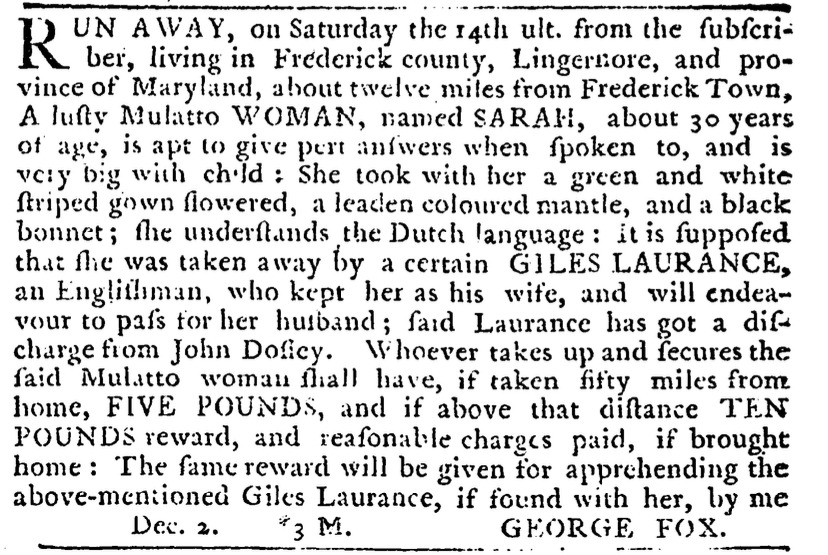
Pennsylvania Journal or Weekly Advertiser, December 2, 1772. Also published March 17, 1773.
While this advertisement may not seem like it matches the other ads at first glance, research suggests this is Rachel’s first runaway attempt. The ad shows that she was living in Frederick County, Maryland and was about 30 years old. Sarah (aka Rachel) is described as being in the later months of pregnancy, and considering the time between the ads would match Bob’s age, this research suggests that the unborn child could be Bob. This would have been a large contributing factor as to why she ran away to escape and give herself and her child a better life as free people. As to why the subscribers are different, it is possible that she may have been sold during this six-year period to Mordecai Gist, the enslaver who posted the following advertisements and owned land in both Frederick and Baltimore Counties in Maryland.
The clothing Rachel took with her is very sparse, implying that she may have run away suddenly without much time to prepare. Rachel is also described as running away with an Englishman named Giles Laurance. The ad states that he kept her as his wife and that the two may pass for husband and wife. These details would have made her recognizable to those looking for her as a result of the ad. Additionally, Giles Laurance had received some kind of discharge from someone named John Dosey; whether this is a militia discharge or an apprenticeship/indentured servitude discharge is unknown at this time.
As the advertisement is posted in a Pennsylvania newspaper as opposed to a Maryland one, and states a reward for a minimum distance of 50 miles, shows that it was believed Rachel could have gotten away to a further distance. Perhaps Rachel had been known to have run away other times, had relatives living in larger cities in the North, or was close enough to waterways that it was possible to get away via ship. Although not much is known of the next six years of her life, she remained resilient and determined to escape slavery as shown in her following attempts to steal herself away.
In October of 1778, she is described as having been recaptured and ran away again, this time at Trenton Ferry.
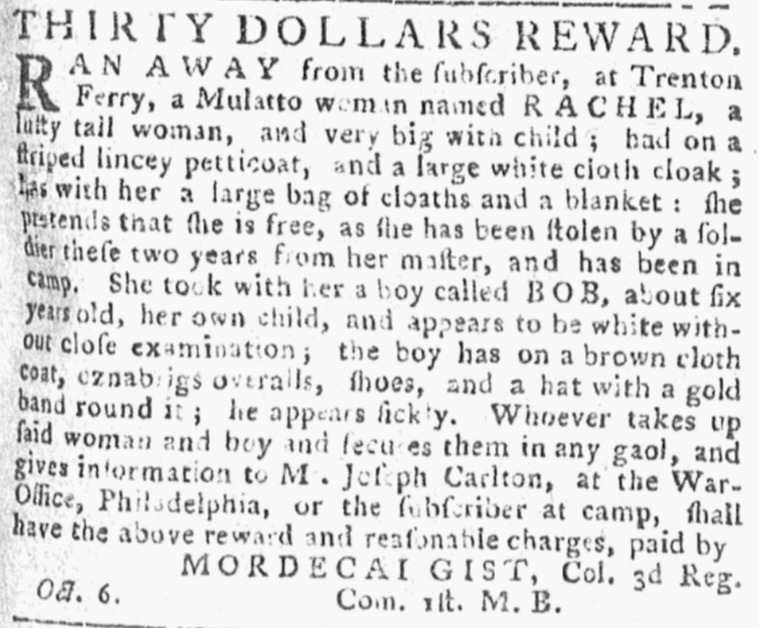
Pennsylvania Packet or Weekly Advertiser, October 15, 1778
This ad was published six years later, in 1778, in the Pennsylvania Packet. Rachel seems to have been possibly sold during this gap of time, as the subscriber is different. Mordecai Gist was a prominent plantation owner outside of Baltimore, Maryland, and was the colonel of the 3rd Maryland Regiment in the Continental Army. Rachel took the opportunity to run away at Trenton ferry, her third documented attempt, with her six-year-old son, Bob. Rachel had run to the army in 1776 and stayed for a period of two years. She may have done this independently, or to follow her husband, a soldier in the army. She’s described as pregnant at the time of her escape, and taking with her a large bag of clothes and a blanket. Rachel’s choices in clothing items would have allowed her the ability to change her dress easily; however, the white cloak would have been distinctive, since cloaks were more commonly red in the eighteenth century. Her son Bob is with her, and the ad notes specifically that he is her child, but appears to be white-passing and sickly. Moving with the army might have helped them blend in and escape unnoticed for a time. However, managing and maintaining their escape after this advertisement was published would have been increasingly difficult as the details of their clothing, appearance, and methods of blending in were mentioned. Trying to remain inconspicuous while caring for a potentially sick child would give her more reason to employ any means necessary to secure their freedom. She most likely took this opportunity to run away, preventing the return to Maryland and bondage, to ensure her unborn child and Bob would grow up as free people.
From October to December of 1778, this advertisement, with a higher reward, was placed in various newspapers.
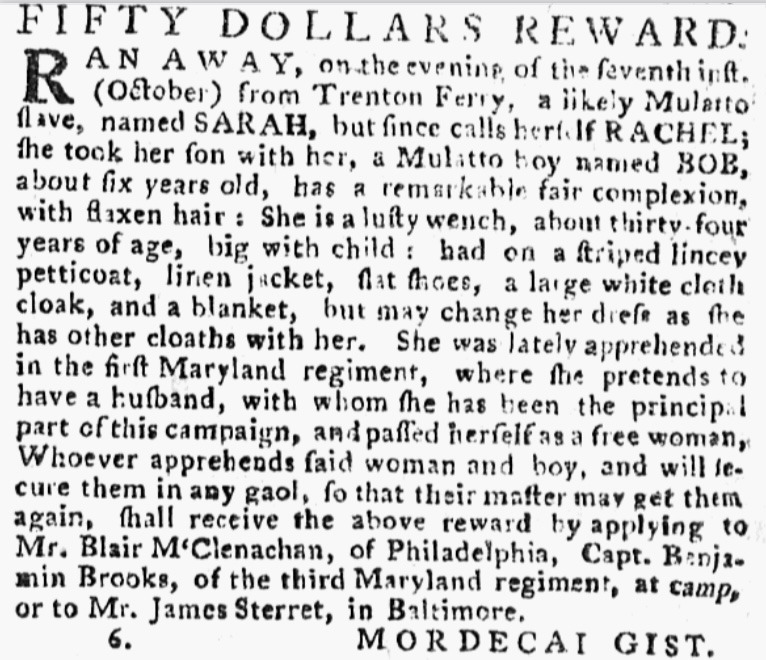
Pennsylvania Packet or General Advertiser, December 1, 1778
This ad was listed multiple times from October 24th to December 1, 1778 across different newspapers such as the Pennsylvania Packet and the New Jersey Gazette. In this ad, Rachel is referred to as Sarah, but prefers to call herself Rachel. This line is one of the few clues that helped connect the first advertisement to this story. Bob’s description is more detailed here; his appearance is noted as having a “remarkably fair complexion and flaxen hair,” meaning blonde hair2. Rachel is said to be about 34 years of age, and most of her description is repeated, but may have changed her clothing in an attempt to go unnoticed. In this ad, it is revealed that she was following in the 1st Maryland Regiment and presented herself as a free woman there. The phrase “pretends to have a husband” indicates a relationship between herself and the soldier, but marriages were often not formally recognized for people of color at this time. As Gist did not name the soldier, it’s likely he did not know the identity of the husband.
From the Trenton ferry, it would have been easier for her to travel via ship down the Delaware River to Philadelphia or Baltimore, with little ways for those looking for her to know which way she went. Mordecai Gist’s advertisement lists individuals across Pennsylvania, New Jersey, and Maryland to report to about someone matching Rachel and Bob’s description, using his resources to cast a wider net in an effort for her return.
It is rare to find more information after this type of ad, as this is often where the story ends. Though this is where research can often be limiting, Rachel and Bob’s story differs as another ad matching their description has been found. Unfortunately, they were captured shortly after the increased reward was published.
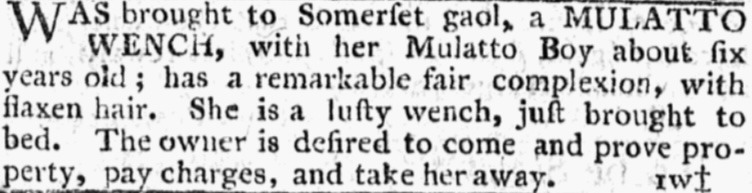
New Jersey Gazette, December 2, 1778
This ad was published the following day, December 2, 1778, in the New Jersey Gazette. Although there are no names posted, the description matches that of Rachel and Bob. They decided to stay in New Jersey, she may have hoped to have gone undetected if enough time had passed, or if they went further north. Rachel may have also hoped to rejoin the 1st Maryland Regiment if they stayed in New Jersey, or that the army’s constant movement would shield them to escape at a later date. Through the short descriptions in all of these ads, it demonstrates how Rachel had to be resourceful at all times to evade capture and being put back into bondage. Due to the higher reward and numerous descriptions, they were unfortunately recognized and brought to Somerset jail. As it currently stands, it is unclear what happened to them after this advertisement was placed.
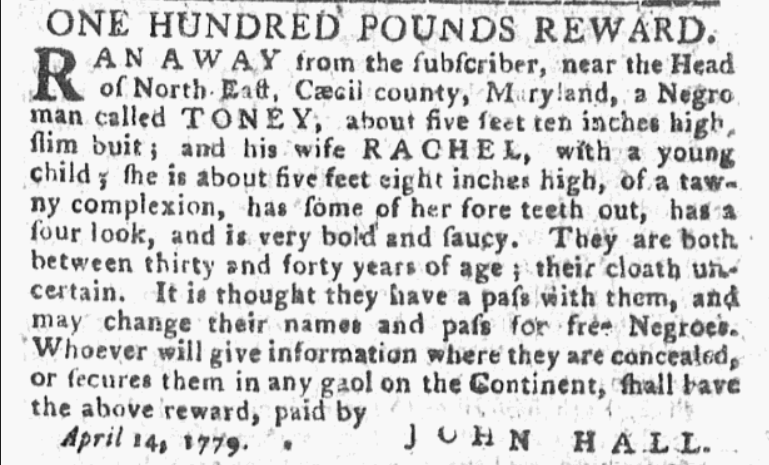
Pennsylvania Packet or Weekly Advertiser, July 10, 1779.
Although it is difficult to say with certainty what Rachel’s life was like after 1778, additional research has revealed another potential advertisement. Assuming that Mordecai Gist took Rachel and Bob back to Maryland, he may have viewed her as a flight-risk and sold her and Bob to another enslaver. The advertisement, while vague, does mention a woman named Rachel (matching her age range) with her young child. However, like many of these types of advertisements, it is almost impossible to know if this is the same person or someone who happens to have the same name and similar details. One key difference is that Toney, her husband, is mentioned to have also run away with them. As there is no mention of a husband matching Toney’s description in the other ads, it could point to this advertisement only resembling that of Rachel and Bob’s descriptions. This tantalizing ambiguity may be left unanswered, but allows for speculation into what may have happened following their capture in 1778.
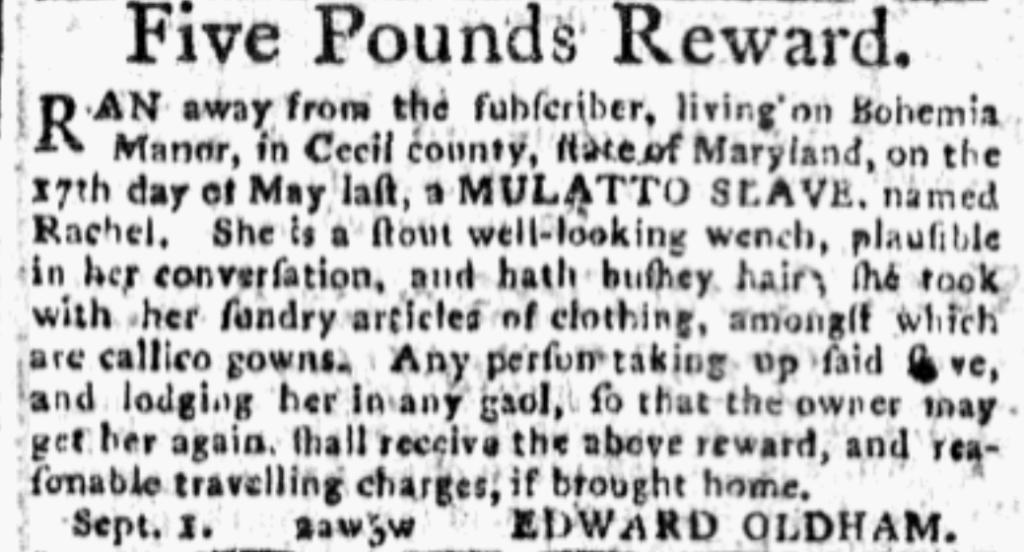
Pennsylvania Packet, October 10, 1788.
Another possible advertisement was found, offering a different look at the events following Rachel’s capture at Somerset, published almost ten years later. Unfortunately, this advertisement’s information is sparse; it does not mention her age or specific details that could connect this to the overall story besides her name. It is possible that Rachel could have been sold multiple times in the ten-year gap and become separated from her son. If that was the case, this could have pushed her to try to reunite with Bob and maintain family ties. Another potential explanation is that this advertisement is referring to a different person, and not the same Rachel in the other advertisements. While the outcome is unclear, it offers another possibility of her continued attempts to obtain freedom and highlights that there might be more to find.
We learn a lot from these glimpses of her story, but they also raise questions, such as: Did she run away previously? Did she run away not only for the chance of freedom but for her child’s health as well? What was her relationship with the soldier? What was her life like in the encampment as a camp follower? Did she continue her attempts to run away after these ads, was she ever able to be free with her children? While it is almost impossible to know the answers to these questions, the information in the ads provide some possible motivations and insight into her story.
Her story shows the courage and resilience it took to escape enslavement and the struggle she went through while trying to make a better life for both herself and her children. While it is unknown what happened to her after this ad, it is hoped to be revealed with continued research. Rachel’s story is one of many we are uncovering and including in our programming for 2026 and beyond.
Link to Maryland State Archive Project: https://msamaryland400.com/2015/02/26/marylands-african-american-troops/
1 Found in “Pretends to be Free”: Runaway Slave Advertisements from Colonial and Revolutionary New York and New Jersey, by Graham Russell Hodges and Alan Edward Brown.
2 The Maryland State Archive project had a different interpretation of what Rachel and Bob might have looked like. Their interpretation of the advertisement is that Rachel, rather than Bob, is the one described as being white-passing. This might have impacted how she blended in the regiment, or how she was able to navigate her escape. This would also change the interpretation of the first advertisement, where it is mentioned that an Englishman would pass for her husband. The commas differentiate between talking about Rachel, then Bob, to continue talking of Rachel’s appearance.